· Company · 4 min read
Not on APISIX? We Will Build Your AI Guardrails Anyway
The AI Act and GDPR apply whatever gateway you run. SafeLLM now also designs and builds the controls your LLM features need on your own stack: PII masking, confidential data that stays in-house, audit logs and numbers measured on your own data.
A pattern we keep seeing: someone finds SafeLLM, reads that it is an AI security gateway for Apache APISIX, and closes the tab. They run Kong, or LiteLLM, or their app calls OpenAI directly. The plugin is not for them.
But the problem that brought them here is still there. A chatbot, a copilot or an agent is about to ship, and legal or the DPO has asked the question every team eventually hears: what exactly goes to the model, and how do you know?
That question does not depend on your gateway. So from today we also take on custom work: we design and build the protections your LLM features need, on the stack you already have.
What the question really involves
“Do not send personal data to the cloud” sounds like one control. In practice it is at least three:
- Personal data. Names, e-mails, phone numbers, national IDs (PESEL, NIP and other EU identifiers), account numbers. These should be masked before a prompt leaves your network, and restored in the answer if needed.
- Confidential text that contains no personal data at all. “The board approved Q3 cuts” has no PII in it. Neither does a draft contract or unreleased results. A PII filter will wave them through.
- Evidence. Logs that show what was sent, what was blocked and why, kept in a form an auditor can read. The AI Act and GDPR care about record-keeping, oversight and data minimisation, not about your architecture diagram.
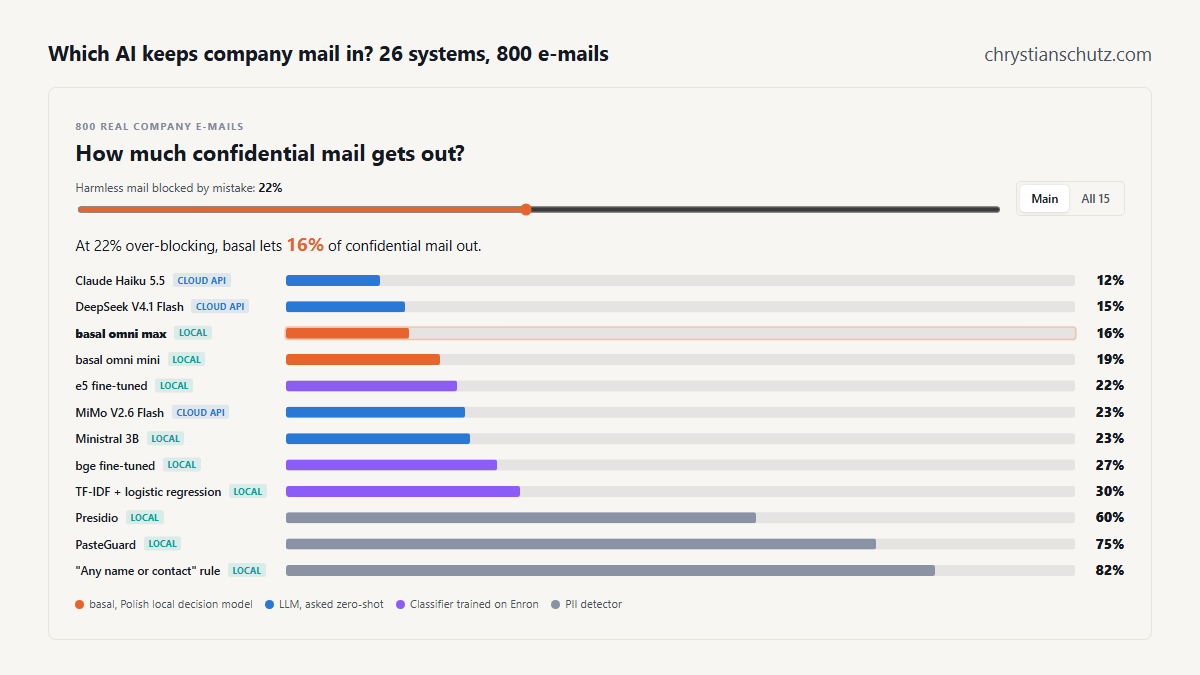
We measured the gap between points 1 and 2. On 800 real company e-mails from the Enron archive, PII detectors let 60–82% of confidential mail through. A small open decision model running locally (basal, from Poland) let 16% out, level with the large cloud LLMs, without the text ever leaving the machine. The full method and the interactive charts are in Which AI Keeps Company Mail In?.
What we build
- AI Act and GDPR readiness for LLM features. We map your AI use cases and data flows, and design the technical controls: logging, human oversight, transparency, data minimisation. We work alongside your legal counsel. We are engineers, not a law firm.
- Guardrails on your stack. PII masking, prompt-injection defence, output DLP and audit logs, built into Kong, Envoy, NGINX, LiteLLM, an OpenAI-compatible proxy or your application code. Open-source components where possible, no lock-in.
- Confidential data that stays in-house. A local decision step that reads context and decides per request whether text may go to a cloud model, with routing to a local model when it may not. CPU-friendly, air-gap capable.
- Evaluation on your own data. Before you trust any filter, including ours, measure it. We label a small sample of your real traffic and report leak and over-blocking rates with confidence intervals, the same method as our public benchmarks.
How it works
- A free 30-minute call. You tell us the feature, the stack and what compliance is asking. We tell you honestly whether we can help.
- A free AI risk snapshot. A short written review: where data leaves, the main gaps, quick wins and priorities for the first 30 days.
- A fixed-scope project. An assessment, a build or both, with the deliverable and the price agreed up front.
- Handover. Code in your repository, documentation your auditor can read, and a session with your team.
And if you are on APISIX
Nothing changes. The open-source gateway stays free, and Enterprise still adds AI-based PII detection, streaming DLP, the dashboard and audit logs. The custom work simply means the same team can help when your case does not fit a plugin.
See how we work or book a free call. Tell us what compliance is asking; we will tell you what to build, and whether you need us for it.